
Daily wages module
The day count that decides what your gang is owed
Wage hands get paid for the days they turned up, and that count often lives in a supervisor's pocket book. VTClock keeps the count and each person's day rate on one employee record, so the amount is worked out the same way every month.
Last reviewed: September 2026
What it does
A wage hand's pay rests on two counts: the days worked, and what a day of his work earns him. VTClock holds both on the same employee record. The days come from the attendance the worker marks near the place he is booked to, and the rate goes in once, changing when you agree a new one with him. There is no column of ticks to add up before anybody gets paid.
The wage is the day rate times the days marked. Where a worker has drawn an advance, the instalment for that month comes off the amount and is printed on the slip, so he can see for himself what has been held back. Where the attendance itself is wrong, an admin sets the record straight before the wage is settled.
How it works
01 Put the wage hands on the same list as the salaried staff
Anybody you pay by the day becomes an employee in VTClock, next to the people on a monthly figure. One list carries the lot, so a hand who works four months a year does not sit outside it in a book of his own.
02 Type the agreed rate against each name
Instead of a month's pay, each wage hand carries the amount you have agreed for one day of work. A loader, a packer and a machine operator are not on one rate, and every one of them keeps his own figure.
03 Book each worker to the place he reports to
A yard, a shed, a plot or a client godown is set up as an office with a boundary drawn around it. The worker is booked to the one he reports to, and marking a day from outside that boundary does not go through.
04 The day is marked on the spot
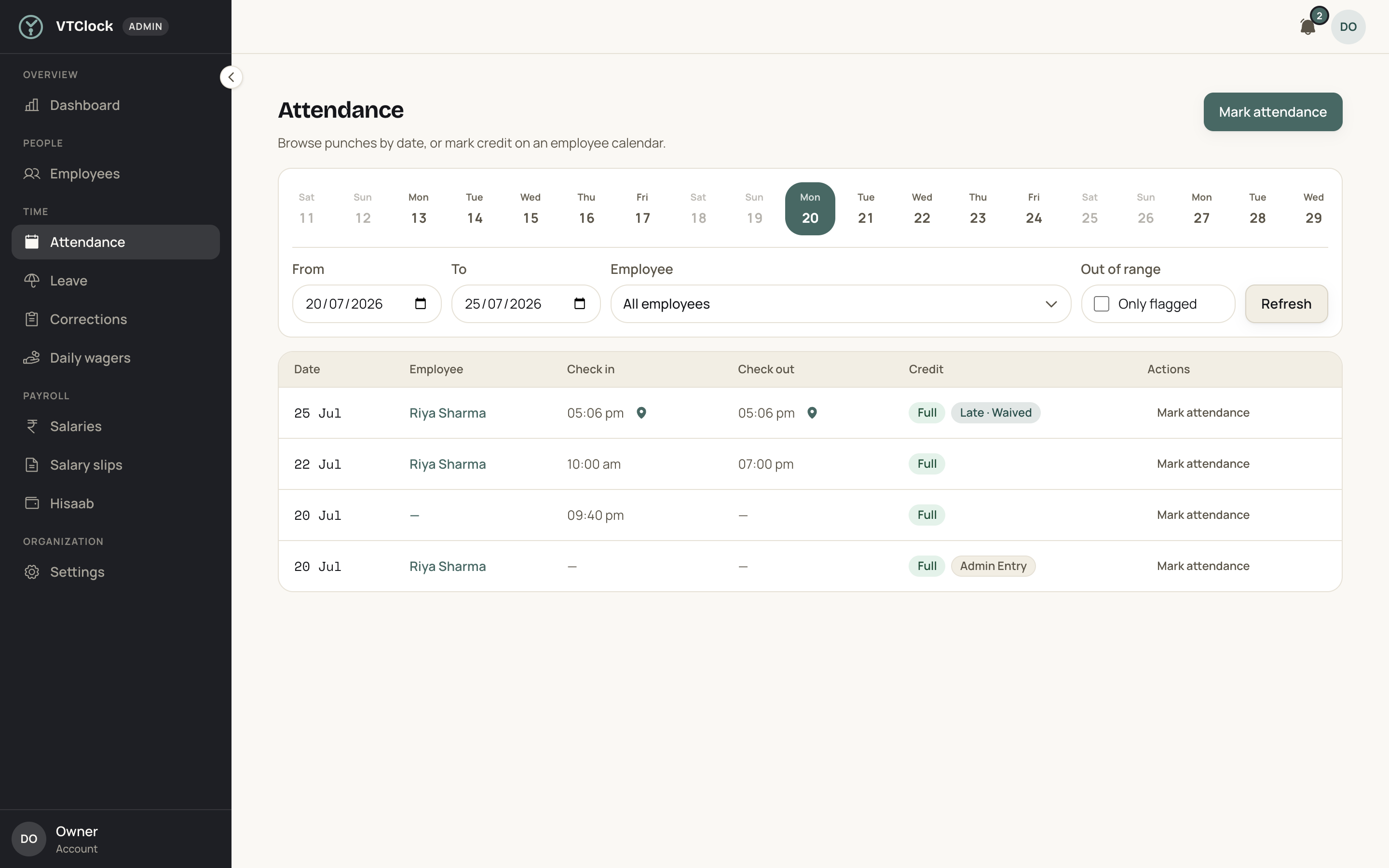
The worker taps the app on his phone at the yard and marks himself in, then marks out when the day is done. Nothing is copied down twice, and the day is on the admin list before anybody has gone home.
05 Record an advance and how it comes back
A worker who wants money in the middle of the month has it logged against his name, with how many months it is recovered over. Nobody has to remember from month to month what is still owed by whom.
06 Settle the month and hand over the slip
Days marked times the day rate is the wage, and the advance instalment set against that month comes off it. The printed slip carries the day count, the earnings and the recovery, so the worker can check the sum himself.
Edge cases it handles
A hand works four months of the year and disappears for the rest
He stays on the list with his rate on him. In a month he did not turn up at all, the record shows no days and the wage works out to nothing, so nobody has to delete him in the slack weeks and type him in again when the work picks up.
You raise somebody's rate in the middle of the month
VTClock holds one day rate against a person at a time. Settle the days already worked at the rate they were agreed on, before you change it, or start the new rate from the first of next month. Whichever you pick, say so when you agree it with him.
Some of the gang is paid by measurement rather than by the day
VTClock counts days and multiplies by a day rate. It does not work out piece rates, so somebody paid per brick, per bag or per length stitched sits outside this figure. Keep those workers on your own measurement book and use VTClock for the ones on a day rate.
A hand who does not read English
The app is in English and there is no regional-language version of it. What a wage hand does in it is put his day in and look at his own slip, which a supervisor can show him once at the gate. Anything past that stays with the admin.
A worker swears he was there on a day the record does not show
Pull up his days on the admin list and look at the one he is arguing about. Where the marking failed and his claim holds, an admin puts the day in and the wage goes up with it. Where it did not, the two of you are looking at one list instead of two versions of the same week.
Who uses it
Contractors
The wage bill is settled with people who keep their own count of the days. Both of you looking at one list on settlement day takes the guesswork out of it.
Warehouses
Loading hands are called in on the days a load comes in and stood down when the yard is quiet. Their days come off the same record the permanent staff use, so none of it lives in a gate diary.
Manufacturing units
A workshop keeps a permanent core on a monthly figure and takes on spare hands when an order is booked. Both sorts of worker sit on one list, each paid on the terms he was hired on.
Restaurants
A wedding banquet wants six more pairs of hands and none again on Tuesday. Each of them is paid for the day he turned up, at the rate he was called in on.
A worked example
Say a packer is on a day rate of INR 610. The record shows 24 days marked for the month, so the wage is 24 x INR 610 = INR 14,640. He drew INR 4,500 in the first week, set to come back over three months, so INR 4,500 / 3 = INR 1,500 comes off this month and the packet is INR 14,640 - INR 1,500 = INR 13,140. A loader on the same gang, at INR 495 a day for 18 days, works out to 18 x INR 495 = INR 8,910 with no advance against him.
Setup checklist
- Add every wage hand as an employee and issue him a login code
- Type the agreed day rate against each name in place of a month's pay
- Add each yard, shed or plot as an office and set the boundary around it
- Book every worker to the place he reports to and the hours he works
- Record any advance still running against a name and the months it comes back over
- Keep your diary going for a fortnight, check the counts against it, then put it away
Frequently asked questions
We pay the gang every Saturday. Can we do that when the slip is monthly?
You can. The day count grows on the admin list from the first marked day, so you can read what each person has done this week and hand him his cash on Saturday against that. The printed slip is monthly. It carries the same days, the wage they add up to, and the advance recovery for the full month, so the Saturday payments and the month-end figure are read off one record.
Do all the hands have to be on the same day rate?
No. The rate sits on each person's own record, so a mason, a bar bender and the fitter on one gang each have a different figure against them, and each wage is worked out from his own. When you agree a new amount with somebody, change it on his record, and the days he marks from then on are counted at the new rate.
The men change every week. Does it pay to put them in an app at all?
That is the case the day count has to answer for itself. Adding a worker takes a name, a day rate, a place and a login code, and he stays on the list when that stretch of work is over, so the next time he comes back there is nothing to set up. What you get in return is a count nobody has to piece together from what people remember in the week you settle.
Is the day count VTClock keeps a wage register in the eyes of the law?
No. VTClock keeps your own record of who worked which day and what the wage worked out to. It is not the register an inspector wants, and it does not check your day rates against the schedule notified under the Minimum Wages Act, 1948 for your state and your category of work. What you are obliged to maintain, and the rate that applies to your trade, are matters for your labour consultant.
Can the wages go out to the workers' accounts once the days are counted?
No. VTClock works out what each person is owed and puts it on a slip that shows how. It does not hold money, make a bank file, or move funds through any channel. You pay the gang the way you already do, in cash at the yard or through your own bank, and the record spells out what each amount was for.
Other modules
- AttendanceGeofenced check-in and check-out near assigned offices, with shift grace, late marks and overnight shifts handled for you.
- Advance salaryGive an advance when staff need one. Recovery spreads over the following months and shows up on every slip.
- Salary slipsBranded, printable slips with earnings, an attendance summary and advance recovery. Staff see the same figures you print.
- SalaryMonthly pay builds from attendance fractions, holidays, weekly offs and approved leave, so there are no side calculations.
Who runs this module
- ContractorsFifteen men on the slab this week and nine of them were somewhere else last week.
- WarehousesPickers, loaders and forklift operators come through one gate on shifts that overlap by an hour, and half of them are paid by the day.
- Manufacturing unitsYour shift in-charge is the only person who knows who stayed back on Tuesday, and by the third of next month nobody can check him.
- Restaurants12 to 20 people, two services a day, and a register that gives the whole thing one line.
- Facility services companiesA facility management company sells deployed headcount, then spends the last week of every month proving it.
- Security agenciesYou deploy guards at client gates you do not own, on day and night reliefs, and the muster sits in thirty registers.
Terms worth knowing
- Daily wageA daily wage is an amount fixed for one day of work and paid for each day the worker actually attends.
- Piece rate wageA piece rate wage pays for output.
- Payable daysPayable days are the number of days a monthly salary is spread across, and the number of days in a given month the employee is actually paid for.
- Advance recoveryAdvance recovery is the taking back of a salary advance through fixed deductions from later pay.
- Attendance registerAn attendance register is the day-by-day record of who was present, absent, late or on leave across a wage period.
- Minimum wagesMinimum wages are the lowest wage an employer may lawfully pay for a given kind of work, fixed by the appropriate government under the Minimum Wages Act, 1948 and carried forward...
See VTClock on your own team
Talk to us on WhatsApp about a walkthrough set up with your own day rates and your own yards.